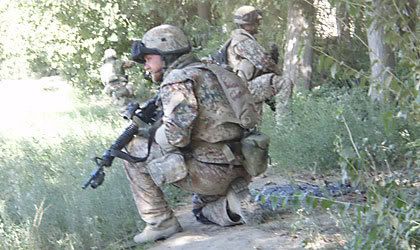
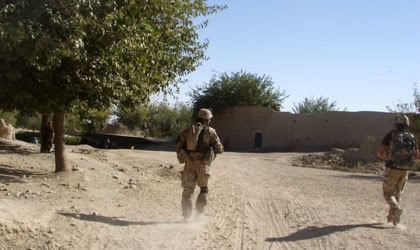
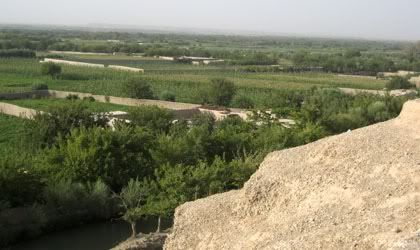
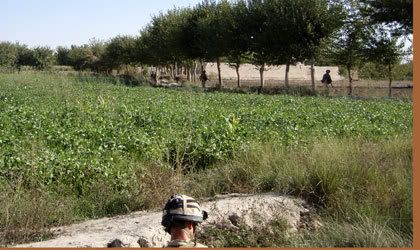
HCR wrote:I met a lot of Danes out there when I was there, good lads and Lasses. We did fall out with them for a while when they refused to leave camp in Masa Qular to help the Pathfinders bug out so we had to do it and we lost 3 lads that day. But I dont know the full reasons why. They were getting hammered there day in day out. Masa Qular was a death trap for who ever was there ask the Royal Irish.
Anyway I tell you who I liked out there. The Estonians. They were'nt many of them but they did more than there fair share and there EOD Team did loads for us. Even though it was probably there Dads in the old Soviet Army that laid the bloody mines in the first place

Pure hell of the siege of Musa Qala.
A little-reported battle against the Taliban in which seven of our troops died has been revealed as one of the fiercest and most heroic of the Afghan campaign.
Lieutenant-Colonel DJ Reynolds
Musa Qala, a besieged outpost deep in Taliban territory, holds a special place in the battle records of the Pathfinder platoon of 16 Air Assault Brigade – and of the Irishmen, Danes and other soldiers who braved face-to-face fighting to relieve them.
When a column at last got through to Musa Qala it found a band of dirty, skinny, heavily armed and bearded defenders. Thanks to luck and skill, none had been killed; but several men had died trying to bring help.
Yet the British public have heard almost nothing about what happened there more than a year ago, early on in the campaign in Afghanistan. Now the men are telling the story of the hidden siege.
The Pathfinders are a deep reconnaissance force drawn from the elite of the Parachute Regiment. The 24-man platoon was the first British unit to clash with the Taliban in Helmand province when they went to the aid of the Afghan police in Musa Qala in May last year. Within a month they were back in Musa Qala – and what was supposedto be a two-day mission turned into an ordeal lasting more than seven weeks.
Four years after the fall of the Taliban the movement was back in control of this part of northern Helmand province. The Afghan government wanted to use the newly arrived British troops to ensure its flag flew over the four district centres of Sangin, Musa Qala, Now Zad and Gereshk rather than the white flag of the Taliban.
In mid-June the Pathfinders were asked to hold Musa Qala “just for a few days” while a way was found of sending in a company of paratroopers. It never happened. For the next 52 days the Pathfinders held off what was at times a relentless assault from Taliban fighters.
From the beginning, the people of Musa Qala showed a reluctance to be drawn into the violence. The area in front of the district centre was the main market and business centre of the town and it was not in their interest to see it damaged by heavy fighting.
Initially the Pathfinders were able to operate reasonably freely, setting up vehicle checkpoints and mounting nighttime patrols. Engineers from 9 Para squadron were sent in to build up the district centre’s defences and repair its poor sanitation.
But intelligence showed that the Taliban were determined to take control of the town, which lay on their route into Sangin. They forced a young woman they accused of assisting coalition forces to watch as her young son was killed and then hanged her publicly, setting a bloody mood for what was to come.
Soon the vehicle checkpoints and the nighttime patrols had to be withdrawn and 4x4 pickup trucks were roaring up the town’s main streets full of Taliban fighters.
A series of unremitting attacks began, ranging from small arms and indirect fire to coordinated full-scale assaults. This report is compiled from the official account made by the soldiers for the regimental history.
One man recalled: “We were attacked daily with everything in the Taliban arsenal – rocket-propelled grenades, Chinese rockets, snipers, mortars, heavy machinegun fire, small arms and their favourite and probably the worst, the recoilless rifle. This piece of kit makes an awesome noise when it’s incoming.”
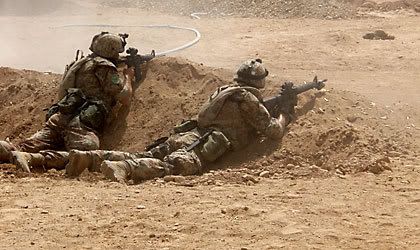
For almost four weeks the Pathfinders were under constant attack. They responded with tens of thousands of rounds from every weapon they had.
“When [the attacks] came it was always a shock. You would sometimes hear the noise of a rocket just a split second before the impact. We had people on guard at all times, they sat in protected bunkers scanning the town with binoculars. On many occasions the initial blast would be followed by an attack, sometimes mounted by up to 10 Taliban, who fired what seemed at the time like thousands of rounds at us.”
With little news emerging of what the British troops were doing in the province, it was the rising number of troops killed in Sangin – news the MoD couldn’t prevent from emerging – that hit the headlines. But the fighting was no less intense in Musa Qala.
Probably because they presented a smaller target and were more experienced than the men in Sangin – and certainly through good luck – the Pathfinders did not lose any men so their story never made the headlines. The Taliban swiftly earned the respect of the experienced paratroopers because of their refusal to back down in the face of the British response.
“The thump of a high-velocity AK-47 round impacting into the wall alongside you forces you to make sure your fire is accurate,” said a Pathfinder. “Your mind is racing, you don’t want to just blast rounds off in case the enemy see your position and correct their aim.” They called in dozens of air and artillery strikes, killing hundreds of Taliban. Nevertheless the attacks continued. The insurgents controlled the roads, and helicopters were vulnerable so there was little chance of resupply. Ammunition, food and water had to be rationed.
“Without resupply, ammunition was now getting short. When we returned fire we made sure that every round counted,” one Pathfinder said.
“The attacks were daily and, without food and water, morale starts to suffer. We survived on our black humour, our training and of course the knowledge that our commanders would get through to us somehow.”
That faith soon turned into a standing joke, but it was becoming far from funny. There was little if any sleep and even less food.
“On one occasion I had been asleep and had just my trousers on, which were torn to bits. My weapon was in my arms and my pistol strapped to my leg. I don’t think any of us slept fully inside Musa Qala, it was just napping and as soon as I heard the bang I was on my feet and running to a firing position.
“As I tried to calm my breathing I saw three Taliban gunmen taking aim at the base. They couldn’t see me – at least I don’t think they could – and I opened up just as one of them fired a rocket-propelled grenade. I put two rounds into him and he hit the deck.”
Fortunately the engineers managed to repair a well inside the compound to provide a limited supply of water. There was some relief when a small team of gunners from 7 Regiment, Royal Horse Artillery, the paratrooper artillery unit, arrived. On July 21, a month after the siege began, a relief column of Danish armoured reconnaissance troops reinforced by British signals specialists left the main British base at Camp Bastion to try to relieve the Pathfinders.
The column reached the outskirts of Musa Qala, only to be attacked from three sides at once. “We were engaged with heavy machinegun fire and rocket-propelled grenades, and to top it off the Taliban had blocked the road with barrels,” said Lance-Corporal Darren “Flames” Sloan, one of the British troops attached to the Danes.
A Danish Eagle armoured vehicle was destroyed by a mine and three crewmen were wounded. The Danes responded with their own heavy machineguns before calling in an American B-1B bomber to deliver the final blow before moving back into the desert to regroup. Inside the Musa Qala compound food and water had run out, and the Pathfinders were drinking goats’ milk. They were feeling isolated and “slightly concerned” as the Danes withdrew.
Five days after leaving Bastion, however, the Danes finally managed to push into the compound to be met by a group of dirty, skinny and unshaven British soldiers, all smiling like seven-year-old schoolboys on Christmas Day.
“Most of us had lost a stone or more and we looked like the wild bunch,” said one Pathfinder. “We were unshaven, long haired, full of fleas and bugs and to be honest we didn’t smell too nice.”
The Taliban gave the relief column a traditional welcome. “There was a crack! The bullet penetrating the sound barrier caught everyone by surprise,” recalled one of the Danes. “The next sound echoing off the walls was the shouting of ‘Medic! Medic!’
“While the rest of the platoon opened fire on the Taliban sniper position Sergeant Karl Mathiesen was brought down with a bullet through the back of his head. Next morning the Danes were amazed to see a British Army air corps Lynx helicopter, which suddenly appeared from nowhere shortly after dawn and nosedived before pulling sharply out of the dive to land perfectly.
“I will never forget that small helicopter suddenly dropping so fast out of the sky,” said a Dane. “Several of us thought for a second that he was going to pile in. He was a very good pilot and very brave. I salute him.”
The nosedive was vital to ensure that the Taliban didn’t have the time to attack the helicopter. The wounded Mathiesen was placed on board and taken back to the main British base at Camp Bastion where he made a good recovery.
The Taliban remained in total control of the surrounding area. The Pathfinders tried to fight their way out on August 1, but a troop of British Scimitar armoured reconnaissance vehicles sent in to extract them was ambushed and the Scimitars were destroyed. Tragically three British soldiers, Captain Alex Eida, 2nd Lieutenant Ralph Johnson and Lance-Cor-poral Ross Nicholls, were killed.
Corporal Mick Flynn was in the Scimitar in front. A 46-year-old veteran of the Falklands who had left the army to run a village shop, he had rejoined to go to Iraq, where he had won the Conspicuous Gallantry Cross, second only to the VC.
Having transferred to Afghanistan, he showed his mettle again by swiftly taking charge of the survivors of the ambush. “We took out the machinegun posts to the front of us and killed them. The Taliban’s main killing group was probably about 10 yards away. There were about 20 or 30 of them. The Taliban were coming down the lane towards us. We killed three but the rest kept firing. We had to fight our way along then jump in a ditch.”
Lance-Corporal Andrew Radford showed tremendous bravery in extracting a wounded colleague under cover from Flynn’s fire. “I talked to the Paras and they sent a company to give us support and to get the bodies out,” Flynn said. “We still had one body unaccounted for. You have to go back for him. You can’t just leave somebody there. There was no question about us not going back.”
The lesson of the ambush on the Scimitars was that only a strong force would be able to pull the Pathfinders out and reinforce the Danes.
Brigadier Ed Butler, the British commander, ordered 300 men to land by helicopter just over half a mile outside the Musa Qala district centre before marching to attack the Taliban.
“Bayonets were fixed,” said Staff Sergeant Bruce Dickinson, “and behind a rolling barrage of artillery and mortars we advanced down the hill and into the compounds, the charges sounding like artillery landing too close for comfort.”
The enemy compounds were empty, having been battered the previous night by B1 bombers. There was some sporadic Taliban small arms fire and tragically Private Andrew Cutts was shot dead. But the relief column reached the besieged troops.
Two platoons from the Royal Irish Regiment replaced the Pathfinders, who drove off in their open-topped Land Rovers smiling and waving. The Irishmen soon found out why their predecessors were so pleased to be leaving Musa Qala. “Within minutes of arriving we received the local welcome,” one of the Royal Irish recalled.
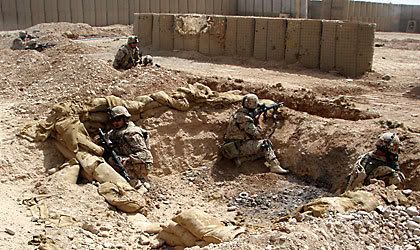
“Our initial impression of the town itself was surreal; it was a ghost town, all civilians had fled before our arrival. It was just the Taliban on the outside and 38 Irishmen and 140 Danish Vikings on the inside.
“Our first impressions of the Danish were that they were superbly equipped and well organised. They had more vehicles, mounted machineguns, heavy machineguns and recoilless rifles than you could shake a stick at. They also had a mobile industrial fridge and water purifier. The Danish rations were far tastier.”
There was no let-off in the number of Taliban attacks. On the third day two soldiers from Somme platoon were airlifted out of the base with gunshot wounds.
After four more weeks of fighting, the Danish squadron drove out of Musa Qala to be replaced by another Royal Irish platoon. “It was just what Musa Qala needed,” one of the regiment’s officers recalled, “another 28 mad Irishmen.” Hours after the Danes left, the insurgents launched the first of a series of massed attacks. All were repelled with the assistance of American and RAF aircraft.
When a Taliban attack destroyed one of their heavy machineguns, the Irishmen made a dummy gun and put it on the “Alamo” position on top of the district centre. The generators running the electric pumps drawing water from the well were held together with superglue.
In four weeks of fighting, the Royal Irish fired a quarter of all the 7.62mm machinegun rounds used by British troops in Afghanistan in the whole of 2006. Inevitably there were casualties. Lance Corporal Jonathan Hetherington was killed on August 27. Four days later Ranger Anare Draiva was killed and a dozen soldiers seriously wounded in a big Taliban assault.
Major Mark Hammond, a Royal Marines helicopter pilot, was sent in to airlift the casualties out. His initial “fast and low” approach came under Taliban attack and had to be aborted. When he got the helicopter back to Bastion four rounds had hit the aircraft, one of them coming close to chopping off a rotor blade.
Undeterred, Hammond went back with a fresh aircraft under yet more heavy Taliban fire to recover the wounded. Sadly one of them, Lance-Corporal Paul Muirhead, was to die five days later with his parents by his bedside.
The local people, anxious to restore normality, approached the British with an unusual offer: if the British would stop fighting the Taliban in the town, they would force the insurgents to leave. It worked, at least for a while.
On October 17 four months of intense fighting came to an end and the Royal Irish pulled out. But in February this year the Taliban returned to Musa Qala.
They were initially blocked by tribal elders but the Taliban killed them. It was a deliberate attempt to provoke the allies into launching an attack on the town. The Americans obliged with a “surgical airstrike” killing a number of civilians. It did not lead to the recovery of the town. Musa Qala remains in Taliban hands.
The Pegasus Journal & DRA Publishing 2007
Adapted from The Battle for Helmand, collated by Lieutenant-Colonel D J Rey-nolds QVRM. Copies can be obtained from DRA Books at 14 Mary Seacole Road, the Millfields, Plymouth PL1 3JY. Cheques should be made out to DRA Books for £25
The heroes who lived, and died
Of the 68 British servicemen killed in Afghanistan since operations began in November 2001, 63 have died in southern Afghanistan, seven at Musa Qala
Lance-Corporal of Horse Andrew Radford won the Conspicuous Gallantry Cross for his bravery in the August 1 operation to relieve Musa Qala
Corporal of Horse Mick Flynn won the Military Cross for his bravery in the operation
Major Mark Hammond of the Royal Marines won the Distinguished Flying Cross for his actions in airlifting casualties
Major Toby Till, commander of the 16 Air Assault Brigade Pathfinder Platoon, was mentioned in dispatches for his actions at Musa Qala
Warrant Officers Chris Mulhall and Thomas Johnstone of the Army Air Corps were mentioned in dispatches for their action in evacuating casualties.
_________________




). We've already got light armour here and apparently the Mechanised are heavier stuff, can't see how the Dane's joining the party will hurt.